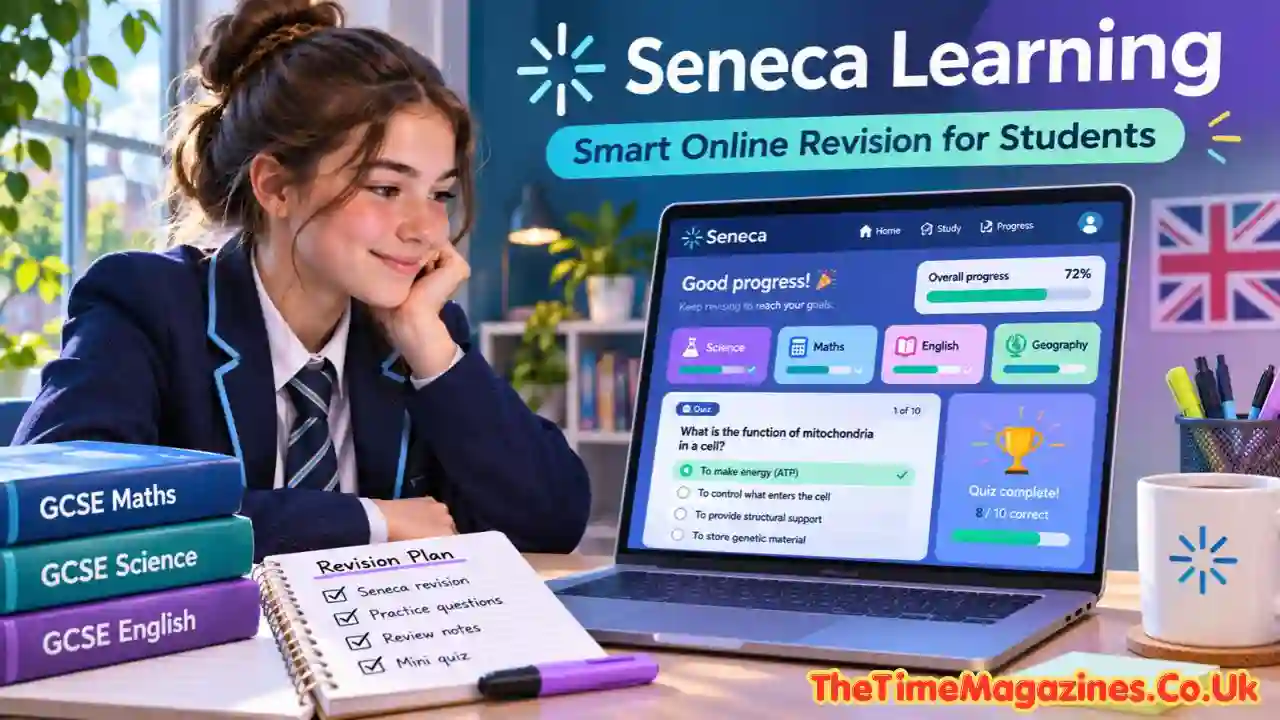
Seneca Learning is an online education platform that helps students revise school subjects, complete homework, and prepare for examinations through interactive lessons and quizzes. Widely used in the UK, it supports GCSE, A-Level, and other school-level learning with curriculum-based materials, personalised practice, and progress tracking.
Unlike traditional revision methods that rely heavily on reading textbooks or copying notes, Seneca encourages students to engage with information through questions and short learning activities. Teachers can assign homework and monitor performance, while parents can follow their children’s academic progress.
Whether you want to understand how Seneca works, access the Seneca Learning login page, explore its mobile app, or find out whether its premium features are worth paying for, this guide covers the essentials.
What Is Seneca Learning?
Seneca Learning is a digital revision and homework platform designed to make studying more accessible and interactive. It provides structured courses covering a wide range of school subjects, with particular emphasis on the UK education system.
Students can study independently or complete assignments set by their teachers. Instead of working through long chapters without checking their understanding, learners encounter short explanations followed by questions that encourage them to recall important information.
The platform supports several educational levels, including Key Stage 2, Key Stage 3, GCSE, and A-Level. Its subject-specific courses help learners focus on topics relevant to their curriculum and examination requirements.
Why Is Seneca Learning Popular in the UK?
Seneca Learning UK has become a familiar name among students looking for accessible online revision resources. Its free educational content makes it particularly useful for families who want additional academic support without immediately committing to a paid subscription.
Teachers also benefit from digital homework tools that simplify assignment creation and progress monitoring. Students can revise at home, during independent study periods, or while preparing for upcoming tests.
Another reason for its appeal is the platform’s straightforward learning structure. Instead of presenting large amounts of information at once, Seneca divides subjects into manageable sections that can be completed individually.
Who Can Use Seneca Learning?
Seneca serves three main user types: students, teachers, and parents.
Students use the platform to revise subjects, answer practice questions, and identify topics that need more attention. Teachers can create classes, assign activities, and review student performance.
Parents can link their accounts to their children’s profiles to see how revision is progressing. This makes Seneca useful beyond the classroom, particularly when families want to establish consistent study routines.
How Does Seneca Learning Work?
Seneca Learning combines educational content with interactive questions, feedback, and learning activities. Students select a course, choose a topic, and work through a sequence of explanations and exercises.
The platform encourages active participation rather than relying entirely on passive reading. Students repeatedly retrieve information from memory, helping them identify what they remember and what they still need to practise.
Interactive Lessons and Questions
Each course is divided into smaller sections covering specific curriculum topics. Students read explanations and respond to different question formats as they progress.
For example, a GCSE Biology lesson about photosynthesis might introduce the process before asking students to identify the materials plants need or explain why light is important.
This approach allows learners to assess their understanding during revision rather than discovering knowledge gaps only when completing an examination paper.
Personalised Learning and Feedback
Seneca uses adaptive learning features to support revision. Student responses and previous activity can influence learning recommendations, particularly through its additional premium tools.
When learners struggle with a topic, they can revisit the relevant material instead of moving forward without understanding it.
Feedback also helps students recognise incorrect answers and review the associated concepts. However, automated feedback should not be treated as a complete substitute for explanations from a qualified teacher.
Tracking Academic Progress
Students can monitor their course activity and identify areas where they may need more practice. Teachers receive information about assigned work and student completion.
This visibility makes it easier to establish revision priorities and spot subjects that need additional attention.
Importantly, high completion percentages do not automatically indicate complete mastery. Students should also practise explaining concepts independently and answering examination-style questions.
Key Features of Seneca Learning
Seneca offers a combination of revision resources, homework management, and performance-tracking tools. Some features are freely available, while others require a premium subscription.
Curriculum-Based Revision Courses
One of Seneca’s strongest features is its collection of courses designed around school curricula and examination specifications.
Students can find learning materials for subjects such as Mathematics, English, Biology, Chemistry, Physics, History, and Geography.
Many courses are organised by examination board, helping learners choose material relevant to their qualifications.
Interactive Quizzes and Practice Exercises
Short quizzes encourage students to recall information immediately after studying it. These activities can reveal misunderstandings before they become persistent learning difficulties.
Question-based revision is especially useful for subjects involving definitions, key facts, scientific processes, and terminology.
However, students should also practise extended writing, calculations, and problem-solving tasks that require more than selecting or remembering a short answer.
Online Homework Assignments
Teachers can use Seneca to assign specific courses or topics to students. Assignments can be completed online, helping schools manage homework without relying entirely on paper worksheets.
Automated marking reduces some repetitive administrative tasks and gives teachers an overview of student responses.
Learning Progress Monitoring
Seneca allows users to review their progress through courses and assignments. This can help students plan revision sessions more effectively.
For teachers, progress information provides a starting point for identifying learners who may need extra support.
Premium Learning Tools
Paid subscriptions provide access to additional learning modes and educational resources. Depending on the subscription, features can include Smart Learning Mode, AI-marked exam questions, premium courses, and AI-assisted learning support.
These extras are designed to complement the free revision experience rather than replace the basic platform.
Seneca Learning Login: How to Access Your Account
The Seneca Learning login process is straightforward for students, teachers, and parents. Users can access the platform through its website or supported mobile applications.
How to Log In to Seneca Learning
- Open the official Seneca Learning website.
- Select the login or sign-in option.
- Choose your preferred sign-in method.
- Enter your account credentials if using email and password.
- Complete any required authentication steps.
- Access your courses, classes, or account dashboard.
Seneca supports email-based authentication as well as Google and Microsoft sign-in options.
Students should use the same authentication method associated with their existing account to avoid accidentally accessing a different profile.
How to Create a New Seneca Account
New users can register without paying for a subscription. During registration, Seneca asks users to provide basic account information and select their account type.
Students may also need to select their school and year group. After registration, they can add relevant courses and begin studying.
Teachers and parents have separate account options designed around their particular responsibilities.
Common Seneca Learning Login Problems
Occasionally, users may experience difficulty accessing their accounts because of incorrect credentials, forgotten passwords, or confusion between personal and school email addresses.
If your Seneca Learning login is unsuccessful, check the email address and authentication method before trying again.
For forgotten passwords, use the available account recovery process. Users receiving access errors should also check whether they are signing into the correct account.
If a school has purchased premium access but the subscription doesn’t appear, the issue may be related to the email address registered with the school.
Is Seneca Learning Free?
Yes, Seneca Learning provides a substantial range of free educational resources. Students can create an account and access hundreds of courses without purchasing a premium subscription.
The free version is particularly useful for everyday homework, subject revision, and developing consistent study habits.
Teachers can also use standard homework assignment and student progress tools without paying for an individual premium plan.
Seneca Learning Free vs Premium
The main distinction between free and premium access is the availability of additional courses and advanced learning features.
| Feature | Free Version | Premium Version |
|---|---|---|
| Account registration | Included | Included |
| Standard revision courses | Included | Included |
| Interactive learning activities | Included | Included |
| Standard teacher assignments | Included | Included |
| Progress tracking | Included | Included |
| Premium courses | Not included | Included |
| Advanced premium learning modes | Not included | Included |
| AI-marked exam questions | Limited or unavailable | Available in eligible packages |
| Subscription payment | Not required | Required |
The exact premium features depend on the package you buy, and school subscriptions differ from individual plans.
Is Seneca Premium Worth the Money?
Seneca Premium may be useful for students who revise frequently and want additional practice, targeted recommendations, or AI-supported feedback.
However, upgrading is not essential for everyone. Students who need curriculum explanations, interactive quizzes, and regular revision exercises may find the free version sufficient.
Before buying a subscription, examine the available features, renewal terms, and current pricing. Consider whether the additional tools address a specific learning need rather than upgrading simply because premium content is available.
Seneca Learning for GCSE Revision
GCSE revision is one of the most common reasons students use Seneca. The platform provides subject-based learning resources that help learners review curriculum topics before assessments and final examinations.
Students can select relevant courses and gradually work through areas they find challenging.
GCSE Science Revision
Seneca supports revision across Biology, Chemistry, and Physics. Students can review scientific definitions, processes, and concepts, then test their understanding through interactive activities.
In Biology, topics may include cells, genetics, ecosystems, and human physiology. Chemistry and Physics courses support the revision of scientific principles and subject terminology.
For calculation-based topics, students should also practise writing equations, showing working, and applying formulas independently.
GCSE Maths and English
Mathematics revision requires regular problem-solving and the ability to apply methods in unfamiliar situations. Seneca can help reinforce mathematical concepts, but learners should combine it with written exercises and examination papers.
English revision involves vocabulary, literary understanding, language analysis, and extended writing. Interactive learning can support knowledge recall, although essay writing and detailed feedback remain particularly important.
Other GCSE Subjects
Seneca also offers courses across humanities and other school subjects, depending on the curriculum and examination board.
History students can use short learning activities to review key events and terminology. Geography learners can strengthen their understanding of physical and human processes.
Whatever the subject, students should check that the selected course matches the specification taught at their school.
Using Seneca Learning for A-Level Revision
A-Level students can use Seneca to revisit important concepts and organise independent revision. This can be helpful when subjects contain large amounts of terminology, theory, or factual material.
However, A-Level assessments often require detailed explanations, evaluation, and extended answers. Short interactive quizzes alone are unlikely to provide enough preparation.
Combining Seneca With Other Study Resources
An effective A-Level revision routine should include several complementary activities.
Students might begin by reviewing a Seneca topic, then write a summary from memory, answer an examination-style question, and compare their response with the marking guidance.
This approach combines knowledge recall with the deeper analytical skills required for advanced examinations.
Seneca Learning App: Study Anywhere
The Seneca Learning app allows users to access revision activities on compatible mobile devices. Official support information confirms that Seneca offers Android and iOS applications.
Students can also use Seneca through a mobile browser, tablet, laptop, or desktop computer.
Features of the Seneca Learning App
The mobile experience allows students to access educational content and continue revision without sitting at a desktop computer.
Teachers using supported features can also manage classes and assignments from mobile devices.
This flexibility makes short revision sessions easier to fit into daily routines, particularly when students have limited access to a computer.
How to Download the App
Android users can search for Seneca Learning in the Google Play Store, while iPhone users can find the application through Apple’s App Store.
After installing the official app, users can sign in with their existing accounts and access their learning resources.
For security, avoid downloading unofficial application packages or entering account credentials on unfamiliar websites.
Seneca Learning Reviews: What Do Users Think?
Seneca Learning reviews provide useful insight into the platform’s strengths and limitations. Feedback from students, parents, and teachers includes both positive experiences and criticism.
Many positive reviews highlight the convenience of interactive revision, the availability of curriculum content, and the ability to divide large subjects into smaller learning sessions.
Other reviewers mention frustrations involving automated marking, technical problems, or questions that do not always accommodate alternative correct answers.
Positive Feedback About Seneca
Users frequently appreciate the accessibility of free revision materials and the straightforward course structure.
Parents may value being able to monitor learning activity, while students often appreciate having subject resources available outside school hours.
Teachers can benefit from a system that reduces the time required to prepare and mark some routine homework exercises.
Common Complaints and Limitations
Some Seneca Learning reviews describe occasional difficulties with question marking or technical performance.
A particular limitation of automated assessment is that answers may need to match an expected format. In subjects such as English Literature or History, valid interpretations can sometimes be more complex than automated marking allows.
Students should question feedback when they believe a correct answer has been rejected. Where necessary, they should discuss the issue with their teacher.
Should You Trust Online Reviews?
Reviews can help identify recurring experiences, but they should not be treated as definitive evidence that a platform will work equally well for everyone.
A student preparing for GCSE Biology may have different requirements from someone studying A-Level English Literature.
The most reliable way to evaluate Seneca is to try the free version, examine the available courses, and decide whether its revision style supports your learning needs.
Understanding the Seneca Learning Logo and Brand
The Seneca Learning logo helps users recognise the official education platform across its website, mobile applications, and related materials.
Students searching for the Seneca Learning logo may be looking for the official website, a school resource, or an image for educational use.
When accessing Seneca, check the official website address rather than relying only on familiar colours or logos. Fraudulent websites can imitate legitimate branding.
Can You Use the Seneca Learning Logo?
Anyone planning to use the logo in a commercial publication, promotional resource, or business project should first check the company’s branding and intellectual property requirements.
Educational references to the platform are different from suggesting that Seneca officially endorses your content.
Avoid altering or displaying the logo in ways that could confuse readers about the relationship between your website and Seneca Learning.
Seneca Learning Jobs and Career Opportunities
People searching for Seneca Learning jobs may be interested in working for the education technology company rather than using its revision platform.
As an educational technology business, Seneca may recruit professionals from fields such as software development, educational content, product management, customer support, and business operations.
Specific opportunities depend on the company’s current recruitment requirements.
What Types of Jobs Might Be Available?
Educational technology companies typically require a combination of technical, educational, and commercial skills.
Software specialists may contribute to developing and maintaining learning systems. Education professionals may work on curriculum materials or assessment content.
Other roles can involve product development, operations, customer support, and communications.
These are examples of relevant career areas, not confirmation that Seneca currently has vacancies in each category.
How to Find Genuine Seneca Learning Vacancies
Anyone interested in working for the company should look for recruitment announcements through official company channels or established professional recruitment platforms.
Before applying, check job descriptions, qualification requirements, employment arrangements, and application deadlines.
Be cautious of recruitment messages requesting payments or sensitive financial details before a legitimate hiring process has taken place.
Benefits of Seneca Learning for Students, Teachers, and Parents
Seneca’s value depends on how it is used. When integrated into a sensible study routine, it can make educational resources easier to access and help users identify revision priorities.
Benefits for Students
Students gain access to structured revision material that can be studied independently.
Short learning activities may make it easier to maintain concentration, while regular quizzes encourage learners to revisit information they might otherwise forget.
Monitoring progress can also make revision feel more manageable.
Benefits for Teachers
Teachers can assign learning activities, review completion information, and identify areas where students appear to be struggling.
Automated marking can reduce the workload associated with routine factual questions, leaving more time for individual explanations and classroom support.
Benefits for Parents
Parents can use connected accounts to follow their children’s learning activity and encourage consistent revision habits.
Progress information may help families identify when additional support is needed, although it should be interpreted alongside teacher feedback and actual assessment results.
What Are the Limitations of Seneca Learning?
Despite its advantages, Seneca is not a complete replacement for conventional teaching or independent exam practice.
Students can sometimes complete short questions successfully without developing the depth of understanding required for challenging examination tasks.
Limited Practice for Extended Answers
Many examinations require students to explain their reasoning, construct arguments, or demonstrate calculations step by step.
Interactive quizzes may support foundational knowledge, but learners still need written practice to develop these skills.
Automated Feedback Is Not Always Perfect
Automated marking systems can struggle with unusual wording, alternative interpretations, and answers that require subjective judgement.
Students should use feedback constructively while recognising that a teacher may be better equipped to assess complex responses.
Internet and Device Requirements
Seneca depends on access to suitable digital technology. Learners with unreliable internet connections or limited device availability may find it less convenient.
For these students, printed resources and offline study materials remain valuable.
Premium Features Carry Additional Costs
Although free courses are widely available, some advanced tools require payment.
Families should consider their educational priorities and budget before purchasing optional services.
Seneca Learning vs Traditional Revision Methods
Digital revision and traditional study techniques serve different purposes. Neither approach is automatically superior in every situation.
| Study Method | Main Advantages | Potential Limitations |
|---|---|---|
| Seneca Learning | Interactive questions, structured topics, progress tracking | May not cover every type of exam skill |
| Textbooks | Detailed explanations and curriculum content | Limited immediate feedback |
| Flashcards | Useful for active recall and memorisation | Less effective when used without understanding |
| Past Papers | Develop examination technique and time management | Can be challenging without sufficient preparation |
| Classroom Lessons | Teacher guidance and opportunities to ask questions | Learning pace may not suit every student |
The strongest revision plans often combine several methods.
For example, students can learn a concept through Seneca, reinforce it with handwritten notes, and then practise applying their knowledge with past-paper questions.
How to Get Better Results With Seneca Learning
Simply opening a revision platform does not guarantee meaningful progress. Students benefit most when they use online resources with clear goals and regularly check what they have learned.
Set Small and Realistic Revision Goals
Rather than attempting to complete an entire subject in one sitting, choose a small number of topics and study them carefully.
A focused session of around 20 to 30 minutes can be a useful starting point, although the ideal duration varies between learners.
Focus on Difficult Topics
Use mistakes and progress information to identify areas where understanding is weak.
Revisiting challenging material is usually more productive than repeatedly completing questions that already feel easy.
Use Active Recall
After finishing a Seneca section, close the lesson and try explaining the topic without looking at the screen.
If you struggle to recall the main points, return to the material and identify what you missed.
Combine Revision With Past Papers
Exam preparation requires more than remembering information. Students must also understand question wording, manage time, and demonstrate knowledge in the required format.
Use Seneca to reinforce concepts, then practise examination questions under realistic conditions.
Review Topics Regularly
Revisiting material across several days or weeks helps strengthen long-term retention.
Instead of doing all revision immediately before an exam, create a timetable with regular review sessions.
Is Seneca Learning Effective for Exam Preparation?
Seneca can be a useful part of an effective revision strategy, particularly because it encourages active participation and repeated knowledge retrieval.
Educational research supports the value of retrieval practice and spaced learning. However, the effectiveness of any particular platform depends on the quality of its content, how consistently it is used, and whether students apply what they learn.
A high quiz score should not be mistaken for guaranteed exam success.
When Seneca Works Best
Seneca is particularly well suited to reviewing factual content, reinforcing definitions, revisiting familiar topics, and checking understanding.
It can also help students who struggle to organise revision by providing a structured sequence of activities.
When Additional Support Is Needed
Students preparing for extended essays, practical assessments, or complex calculations should use other resources alongside Seneca.
Teacher feedback, textbooks, worked examples, and official examination materials can help develop skills that short quizzes do not fully assess.
Frequently Asked Questions About Seneca Learning
What is Seneca Learning used for?
Seneca Learning is used for online revision, homework assignments, and examination preparation. Students complete interactive lessons and questions, while teachers can assign work and track learning activity.
Is Seneca Learning completely free?
Seneca offers hundreds of free courses and standard learning features. Optional premium subscriptions provide additional educational content and advanced tools.
How do I access my Seneca Learning login?
Visit the official Seneca Learning website or open its mobile application. Use the email, Google, or Microsoft sign-in method associated with your account.
Is Seneca Learning good for GCSE students?
Seneca can help with GCSE revision because it offers curriculum-based courses, interactive questions, and structured topic review. Students should also practise past papers and longer examination answers.
Does Seneca Learning have an app?
Yes. Seneca provides mobile applications for Android and iOS. The platform can also be accessed through compatible web browsers.
Can I use Seneca Learning without a school account?
Yes. Students can register independently and use free revision materials without needing a teacher to create an account first.
What do Seneca Learning reviews say?
Reviews include praise for its accessible revision resources and interactive learning format. Some users also report technical difficulties or frustration with automated question marking.
Can parents see their children’s progress?
Seneca provides parent accounts that connect to student profiles, allowing parents to track progress and support revision at home.
Is Seneca Learning only available in the UK?
Seneca has a strong focus on the UK curriculum. Access and certain services may differ by region, so international users should check which courses and features are available.
Does Seneca Learning guarantee better exam grades?
No online learning platform can guarantee examination results. Seneca can support revision, but performance also depends on understanding, consistent practice, exam technique, and individual circumstances.
Where can I find Seneca Learning jobs?
Check the company’s official recruitment channels and reputable professional job platforms for current vacancies. Available positions and application requirements may change.
Can teachers set homework through Seneca?
Yes. Teachers can create classes, assign revision activities, and review student progress using Seneca’s homework management features.
Final Thoughts: Is Seneca Learning Worth Using?
Seneca Learning offers a convenient way for UK students to revise school subjects, complete homework, and strengthen their understanding through interactive activities. Its extensive selection of free courses makes it an accessible option for learners who want additional support outside the classroom.
For teachers, the platform provides useful homework management and monitoring tools. Parents can also benefit from greater visibility into their children’s study habits and academic progress.
Its limitations are worth recognising. Short quizzes and automated feedback cannot replace everything that happens in a classroom, particularly when students need detailed explanations, extended writing practice, or individual guidance.
The best approach is to treat Seneca as one part of a balanced revision routine, not a complete educational solution.